

Most electrolyte drinks are built around one mineral: sodium. That makes sense if you're running an ultramarathon in August. It makes a lot less sense for the other 99% of hydration occasions. Here's what your electrolyte drink is probably missing, why it matters for performance, and what a smarter formula actually looks like.
The Sodium Problem
Open any electrolyte drink and check the label. Sodium is almost always the headline mineral. LMNT has 1,000mg per packet. Gatorade has 160mg per 12oz. Liquid I.V. has 500mg. The message is clear: more sodium equals better hydration.
For endurance athletes losing liters of sweat in extreme conditions, high sodium makes sense. Sweat is salty. Replace what you lose.
But most people using electrolyte drinks aren't running ultras. They're working out for an hour. Going for a hike. Sitting at a desk wondering why they feel foggy at 3pm. And the average American diet already delivers over 3,400mg of sodium per day - well above the 2,300mg recommended limit.1
Americans already consume 150% of their daily sodium needs through food alone. Meanwhile, less than 2% of adults meet the adequate intake for potassium, and roughly 50% are estimated to be magnesium-deficient. The minerals most electrolyte drinks emphasize are the ones most people already have plenty of.23
The Minerals That Actually Matter
Your body runs on four major electrolytes: sodium, potassium, magnesium, and calcium. You lose all four when you sweat. But the amount you need to replace depends on what your diet already provides - and what it doesn't.
Potassium: The Intracellular Driver
Potassium is the primary electrolyte inside your cells. It regulates fluid balance, drives nerve impulses, and enables muscle contraction. Every time you flex a muscle, potassium is doing work.4
A 2015 review in Advances in Nutrition found that higher potassium intake was associated with lower blood pressure, reduced risk of stroke, and better overall cardiovascular health. The adequate intake is 2,600-3,400mg per day. Average American intake: about 2,500mg. Nearly everyone falls short.4
For exercise specifically, potassium depletion impairs muscle contractility and can contribute to cramping, weakness, and fatigue. A potassium-forward electrolyte drink addresses the mineral most people are actually missing.
Magnesium: The Recovery Mineral
Magnesium is involved in over 300 enzymatic reactions in your body, including energy production, protein synthesis, and muscle and nerve function. It's also one of the most common deficiencies in developed countries.3
For active people, magnesium is directly tied to performance and recovery:
Magnesium enables muscles to relax after contraction. Low levels contribute to cramps, spasms, and stiffness post-workout.
Magnesium supports sleep quality and reduces exercise-induced inflammation - two pillars of post-workout recovery.5
Every molecule of ATP - your body's energy currency - requires magnesium to function. Low magnesium means less available energy.
Magnesium helps regulate potassium levels inside cells. Without adequate magnesium, your body can't use potassium effectively.6
A 2017 review in Scientifica concluded that magnesium supplementation may improve exercise performance in magnesium-deficient individuals, which - given that roughly half the population doesn't get enough - includes a lot of people who think their electrolyte drink has them covered.5
What Most Electrolyte Drinks Actually Contain
Here's what the labels don't advertise:
Electrolyte Profiles Compared
Per serving. Sorted by sodium content (highest to lowest). All values from official nutrition panels.
The pattern is clear: most major electrolyte brands lead with sodium and skip magnesium entirely. Ultima and VYV are the exceptions - both put potassium first. VYV adds prebiotic fiber and real juice on top of the electrolyte profile, which no other brand on this list does.
Who Actually Needs a Sodium Bomb?
High-sodium electrolyte formulas have a legitimate use case: prolonged endurance exercise (2+ hours), high heat and humidity, heavy sweaters, and people on very low-sodium diets. If you're running a marathon in July, you're losing meaningful sodium through sweat and need to replace it aggressively.
But that describes a small fraction of the people buying electrolyte drinks. For the rest of us:
- A one-hour gym session loses roughly 400-800mg of sodium through sweat - easily replaced by your next meal
- The average American meal already contains 1,000-1,500mg of sodium
- Your kidneys are extremely efficient at retaining sodium when levels drop
- Meanwhile, your body has no effective mechanism for storing potassium or magnesium - you need a daily supply
A 2014 study in the British Journal of Sports Medicine challenged the assumption that sodium supplementation during exercise prevents cramping or improves performance in most athletes. The researchers found no consistent evidence that sodium loading provides benefit during exercise lasting less than two hours.7
If your diet already gives you 3,400mg+ of sodium per day, and you're not exercising for hours in extreme heat, do you really need an electrolyte drink that adds another 500-1,000mg? Or would you be better served replacing the minerals your diet is actually short on?
Why VYV's Ratio Is Different
VYV was designed for daily hydration - the gym, the office, the trail, the afternoon crash. Not the ultra-marathon. The electrolyte profile reflects that:
VYV Electrolyte Profile: 455mg Total
Per 12 fl oz can. All four essential electrolytes, weighted toward what most people lack.
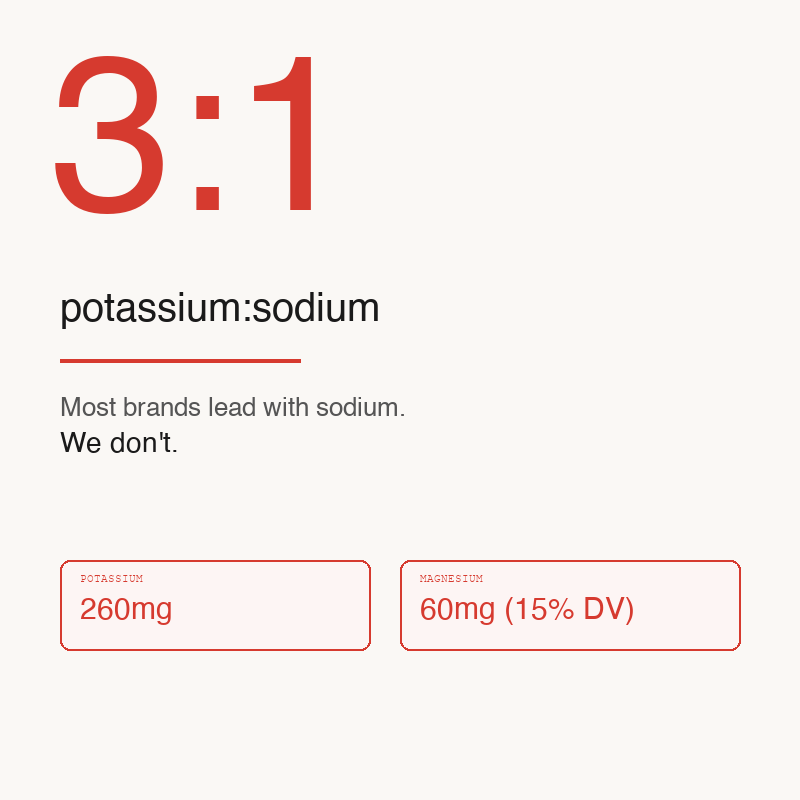
Potassium leads. 260mg per can, nearly 3x the sodium content. This is the inverse of every major electrolyte brand. For people whose diets are already sodium-heavy and potassium-light, this ratio makes more physiological sense.
Magnesium is meaningful. 60mg per can delivers 15% of your daily value - the highest percentage of any mineral on our label. Most electrolyte drinks contain zero. For recovery, sleep quality, and muscle function, this matters.
Sodium is present but not the star. 95mg is enough to support hydration without piling onto the 3,400mg your diet already delivers. It's there because your body needs it for fluid absorption. It's not there because we're trying to replace what a two-hour run took from you.
What This Means for Your Workout
If your exercise routine looks like most people's - 30-90 minutes, moderate to high intensity, not in extreme heat - here's what the research suggests your body actually needs:
- Fluid replacement - straightforward. Drink when thirsty.
- Potassium - supports muscle contraction during exercise and prevents post-workout fatigue
- Magnesium - enables energy production during exercise and supports recovery after
- Sodium - needed for fluid absorption, but your next meal will more than replace what you sweated out
VYV also delivers 5g of prebiotic fiber and real fruit juice - things that have nothing to do with electrolytes but have everything to do with what your body needs daily. It's not an either/or between hydration and nutrition.
The Bottom Line
The electrolyte drink market has convinced people that more sodium equals better hydration. For extreme endurance athletes, that's true. For everyone else, it's marketing.
The minerals most Americans actually lack - potassium and magnesium - are the ones most electrolyte drinks underdeliver or skip entirely. VYV's 3:1 potassium-to-sodium ratio isn't contrarian for the sake of it. It's built around what the average active person's body is actually short on.
Check your electrolyte drink's label. If sodium is the biggest number, ask yourself: is that what your body needs more of?
455mg Electrolytes. Potassium-Forward. 15% DV Magnesium.
Plus 5g prebiotic fiber, real fruit juice, zero added sugar. Sparkling.
Try the Variety PackSources and references
1. Mente A, O'Donnell M, Rangarajan S, et al. Urinary sodium excretion, blood pressure, cardiovascular disease, and mortality. Lancet. 2018;392(10146):496-506. PMID: 31042924
2. Cogswell ME, Zhang Z, Carriquiry AL, et al. Sodium and potassium intakes among US adults: NHANES 2003-2008. Am J Clin Nutr. 2012;96(3):647-657. PMID: 22854410
3. Rosanoff A, Weaver CM, Rude RK. Suboptimal magnesium status in the United States: are the health consequences underestimated? Nutr Rev. 2012;70(3):153-164. PMID: 22364157
4. Weaver CM. Potassium and health. Adv Nutr. 2013;4(3):368S-377S. PMID: 26404370
5. Zhang Y, Xun P, Wang R, et al. Can Magnesium Enhance Exercise Performance? Nutrients. 2017;9(9):946. PMID: 28526392
6. Whang R, Whang DD, Ryan MP. Refractory potassium repletion: a consequence of magnesium deficiency. Arch Intern Med. 1992;152(1):40-45. PMID: 1615908
7. Schwellnus MP, Nicol J, Laubscher R, Noakes TD. Serum electrolyte concentrations and hydration status are not associated with exercise associated muscle cramping (EAMC) in distance runners. Br J Sports Med. 2004;38(4):488-492. PMID: 24668048

